Water Therapy: What the Science Actually Says About Healing in the Ocean
Published by Fluid Focus | Nervous System Health & Ocean Wellness
The phrase "water therapy" gets used loosely—to describe everything from hydrotherapy pools in clinical rehabilitation to a morning swim that simply makes someone feel better. The range is so wide it risks becoming meaningless.
But underneath the loose language, there is a body of research that is worth taking seriously. Water — specifically immersion in and sustained exposure to natural bodies of water — produces measurable changes in human physiology. Not because it is mystical. Because the nervous system responds to it in ways that are predictable, replicable, and increasingly well understood.
This post is an attempt to explain what water therapy actually is, what the science supports, and why immersive ocean experiences represent one of the more effective applications of its principles.
Defining Water Therapy
In clinical settings, water therapy — also called hydrotherapy or aquatic therapy — refers to structured therapeutic interventions conducted in water. These are used in physiotherapy, rehabilitation medicine, and mental health treatment, and they have a well-established evidence base for conditions including musculoskeletal injury, chronic pain, anxiety disorders, and depression.
The mechanisms that make water effective in clinical contexts are the same ones that operate in recreational and immersive settings. Understanding them shifts the conversation from anecdote to physiology.
The Physiology of Water Immersion
When the human body enters water, several simultaneous physiological changes occur.
Hydrostatic pressure acts uniformly across the body's surface, compressing peripheral tissue and redirecting blood flow toward the core and cardiac system. This increases cardiac stroke volume and reduces the heart's workload — an effect that has been compared to mild cardiovascular training even at rest.
Thermoregulation demands shift. In cool water, the body activates heat-conserving mechanisms that include peripheral vasoconstriction and a redistribution of blood to vital organs. This response overlaps significantly with the parasympathetic activation associated with rest and recovery.
The mammalian dive reflex — one of the most well-documented autonomic responses in human physiology — triggers upon facial immersion in water. Heart rate slows. Blood is preferentially routed to the brain and heart. Metabolic rate decreases. This reflex is present from birth and operates independently of conscious intention. It is, in effect, the body's built-in downregulation response.
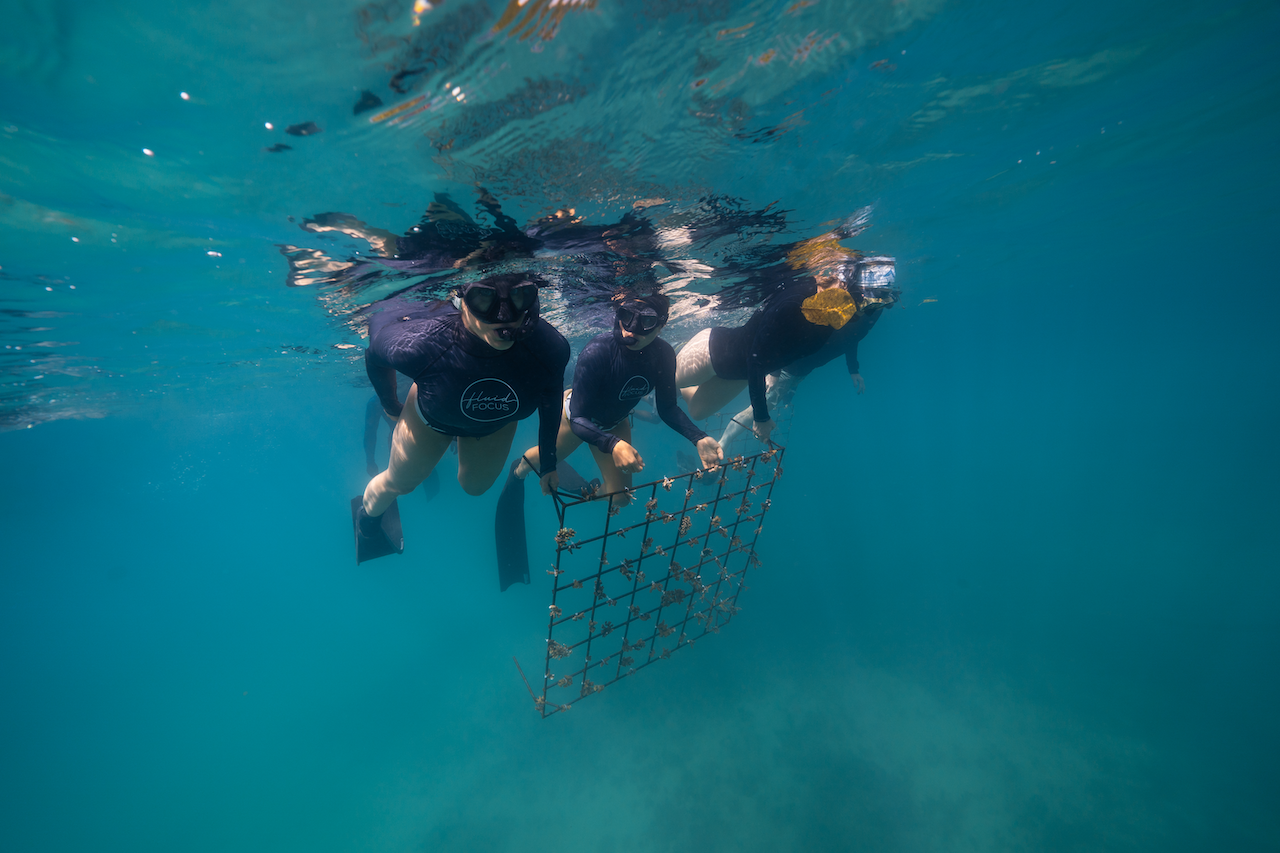
For those new to the sport, an introduction to freediving trains this reflex deliberately and repeatedly. With practice, the dive reflex becomes more pronounced, the heart rate drop more significant, and the practitioner's ability to remain calm during physiological stress measurably improves.
Blue Space Research: What We Know
The academic study of how natural water environments affect human wellbeing has expanded considerably over the past fifteen years. Researchers use the term "blue space" to refer to natural aquatic environments — oceans, lakes, rivers — and their effects on psychological and physiological health.
Key findings from this body of research include:
Reduced stress markers. Multiple studies have found lower salivary cortisol levels in individuals who spend time near or in natural water environments compared to urban or green space controls. The effect is consistent across cultures and geographies.
Improved mood and reduced anxiety. A large-scale study using the Urban Mind app, tracking participants across multiple European cities, found that proximity to water was associated with significantly higher positive affect and lower anxiety ratings — effects that persisted for a period after leaving the water environment.
Restoration of directed attention. Attention Restoration Theory, developed by Rachel and Stephen Kaplan, proposes that natural environments — and particularly water environments — support the recovery of directed attentional capacity. The ocean's visual field is expansive and involuntarily engaging, which allows the prefrontal cortex to recover from the sustained directed attention that modern work demands.
Reduced inflammatory markers. Emerging research suggests that regular cold or open-water swimming is associated with reductions in inflammatory cytokines. Chronic low-grade inflammation is implicated in depression, cognitive decline, and cardiovascular disease — making this a physiologically significant finding.
None of these effects require belief. They require exposure.
Where Immersive Water Therapy Differs From Passive Exposure
Sitting by the ocean and actively training in it are different interventions — both valuable, neither equivalent.
Passive blue space exposure supports restoration. It reduces input, widens the visual field, introduces negative ions produced by moving water, and allows the nervous system to settle without demand.
Active immersive water therapy — particularly breath-hold diving and structured aquatic training — does something additional. It introduces controlled stress within a regulating environment. This distinction matters.
When a person learns to manage rising carbon dioxide during a breath-hold dive, they are not simply relaxing. They are training their nervous system to tolerate discomfort without escalating it into panic. The urge to breathe is physiologically uncomfortable, but the body is not in danger. Recognising that gap — between sensation and threat — is a learnable skill. And it is one that transfers.
Participants who develop CO₂ tolerance through freediving consistently report changes in how they respond to stress on land. The physiological mechanism is the same: the brain receives an uncomfortable signal, the trained response is to observe rather than react, and the wave of discomfort passes without catastrophic interpretation.
This is not metaphor. It is the same neural pathway, applied in a different context.
The Role of Breathwork in Water Therapy
No serious water therapy practice exists independently of breath. The two are inseparable.
In freediving, breathwork is both preparation and practice. Pre-dive breathing protocols — typically involving slow, diaphragmatic breathing with extended exhalation — activate the parasympathetic nervous system before immersion begins. Heart rate slows, muscle tone decreases, and the body enters a state of readiness rather than bracing.
Extended exhalation specifically stimulates the vagus nerve — the primary pathway of the parasympathetic nervous system — through its influence on the respiratory sinus arrhythmia. This is the mechanism behind a wide range of clinical breathwork interventions, including those used in the treatment of PTSD, panic disorder, and generalised anxiety.
Water and breath, practiced together, create a compounding regulatory effect. Neither is sufficient alone. Together, they produce changes in baseline nervous system tone that outlast the session.
What Structured Water Therapy Looks Like in Practice
An immersive water therapy retreat, properly designed, is not only a series of light ocean experiences. It is a structured progression of physiological and psychological exposure, through a comprehensive 7-day program.
A well-designed program includes:
Progressive breath training — beginning with foundational diaphragmatic mechanics, advancing through CO₂ tolerance tables, and integrating breath awareness into movement and stillness.
Graduated water immersion — from surface relaxation and breath holds, through shallow dives, to deeper immersion as tolerance develops. Progression is determined by physiological readiness, not performance goals.
Somatic awareness practices — yoga, body scanning, and mindfulness techniques that improve interoception and support the integration of water-based learning onto land.
Structured reflection — not group processing for its own sake, but deliberate integration periods that allow nervous system consolidation. Silence and stillness are used intentionally.
Skilled facilitation — instructors trained in both aquatic physiology and nervous system regulation, who can distinguish between productive discomfort and genuine distress.
The outcome is not a peak experience. It is a trained response — one that participants carry into the environments that originally generated their stress, often leading to a PADI Freediver certification.
A Note on What Water Therapy Is Not
Water therapy does not eliminate the sources of stress in a person's life. It does not resolve trauma. It does not replace clinical care when clinical care is indicated.
What it does is expand the window of tolerance — the physiological range within which a person can experience stress without being overwhelmed by it. Within that wider window, better decisions are made, relationships are navigated more clearly, and recovery from difficulty is faster.
That is a modest claim. It is also a durable one.
The ocean has been regulating human nervous systems for as long as humans have been near it. The science is finally catching up to the experience.
Fluid Focus retreats combine freediving, breathwork, yoga, and structured water immersion to train nervous system regulation — held across Indonesia and beyond. View upcoming retreats →
Subscribe to theWaterBrain
You can explain vagal tone, yet you still clench your jaw at 3pm. There's a difference between understanding regulation and being regulated. theWaterBrain newsletter covers that gap along with everything else ocean related and awesome. Bi-weekly and free.